

“I’m 19 weeks pregnant, due at the end of December - we’re having a Christmas baby! After everything we’ve been through, I still can’t quite believe it’s real.”
Read more →Virtual fertility care.Innovative insemination treatment.All from the comfort of home.
When trying naturally isn’t working but you’re not ready for IVF, there’s a step in between. Explore insemination treatment and ovulation medication, with a fertility nurse to support you.
The treatment step before IVF, with a fertility nurse by your side.
- FDA-cleared Class II device
- Ongoing fertility nurse support
- Prescribed by licensed OBGYNs
- HSA/FSA eligible

Fertility care that comes to you.
Béa brings key parts of in-clinic fertility care to the comfort of your home, guided by experienced fertility nurses every step of the way.

1Insemination treatment
Places sperm where it needs to be.
The Béa Applicator and cervical cap place 3.23× more sperm at your cervix than sex.¹
How insemination works ↓
2Ovulation medication
Helps the egg show up on time.
Low-dose oral medication, prescribed by a licensed OBGYN if right for you, and shipped to your door.
How medication works ↓
3Virtual care
Connects you with a fertility nurse.
Start with a video appointment to help get you set up, and message a fertility nurse anytime for support.
Meet your care team ↓39% of Béa users reported a pregnancy within three cycles.²
Reported through a retrospective analysis of a cohort of 56 couples undergoing three cycles of the Béa insemination treatment.
Trustpilot
Excellent · TrustScore 4.3 · 4,500+ treatment cycles and counting
41% pregnancy rate in couples with male factor infertility.²
That’s the Béa Applicator doing the job it was designed to do: helping as many sperm as possible make it to the egg.
Meet the cohort
Béa’s first treated cohort
- Couples
- 56
- Average female age
- 37.6
- Trying to conceive for more than 6 months
- 89%
- Trying to conceive for more than 12 months
- 57%
- Reported a female reproductive condition
- 43%
- Reported PMOS
- 14%
- Male infertility or abnormal semen analysis
- 30%
- Reported miscarriage
- 4
- Reported adverse events
- 0
Observational and self-reported, with no control group. Reported pregnancy, not live birth. Results vary and are not guaranteed.
Fertility support, minus the clinic visits.
Fertility clinics monitor your cycle with scans and blood tests. We help you find your fertile window at home, with a fertility nurse by your side. Expert guidance, without the waiting rooms.
“The support is very quick, very good and fast. Everything you need is right there.”
| At a fertility clinic | With Béa | |
|---|---|---|
| Getting started | Referral, then often a waitlist | Free online eligibility assessment |
| Cycle monitoring | 3+ in-person appointments every cycle for scans, vaginal ultrasounds and blood tests | Ovulation tests at home, supported by a fertility nurse |
| Medication | High-dose injectable medication, with in-clinic monitoring, needles and hormones | Low-dose oral ovulation medication, prescribed by an OBGYN only if it’s right for you |
| Insemination | IUI: invasive, expensive, on the clinic’s schedule, 1 attempt per cycle | At home, in your own time, with 2 insemination tries every cycle |
| Support | Call or email the clinic, then wait to hear back | Text or email your fertility nurse directly, Monday to Friday |
| Cost per cycle | About $1,363 for IUI³ | From $150 |
No “keep trying”, referral or waitlist.
Start treatment on your timeline, and on your terms.

1Check you’re eligible
A free 2-minute online eligibility assessment checks whether a Béa treatment plan is safe for you to use.⁴

2Choose your treatment
Insemination treatment on its own, or with ovulation medication if a licensed OBGYN prescribes it.

3Start at home
Everything ships to your door in discreet packaging, with step-by-step guidance for your cycle.

4Stay fully supported
A fertility nurse you can reach out to by text or email, for guidance on your next step and peace of mind along the way.

Every Béa plan includes
- HSA/FSA eligible
- Pay in interest-free installments
- Discreet delivery to your door
- Text or email your fertility nurse directly whenever you need
Treatments available
Not sure which is right for you? Your free assessment helps you decide.

Insemination treatment
From $150 a cycle
FDA-cleared insemination treatment with fertility nurse support.

Medicated inseminationNew
From $298 a cycle
Insemination treatment plus ovulation medication, prescribed by a licensed OBGYN if it’s right for you.

Ovulation medicationNew
From $142 a cycle
Ovulation medication on its own, prescribed by a licensed OBGYN.
Intracervical insemination: a clinical fertility treatment, reinvented for home.
Intracervical insemination (ICI) places sperm right at the cervix, giving it a head start toward the egg. Fertility clinics have used it for decades. The Béa Applicator, an FDA-cleared Class II medical device, makes it possible at home. No clinic, no exam table, and you go at your own pace.
See insemination treatment →
- Easy-pour funnel No intercourse needed. Pour in partner or donor semen, then remove the funnel. No spills. A sterile semen container is included for partner samples.
- Medical-grade silicone cervical cap Forms a soft seal around your cervix, keeping sperm protected and in place against cervical mucus.
- Easy removal string No fingers inside your body, and no mess.
- 7-inch insertion length Designed to fit a wide range of bodies, placing sperm straight at the cervix and helping it bypass the acidic vaginal environment.
- Twist-handle deployment A slow 360-degree turn of the handle gently releases the cap against your cervix, so you stay in control.
 1Shields sperm from the vagina2Holds sperm at the cervix
Two simple reasons ICI works.
Protects sperm from an acidic vaginal environment.
The vagina is naturally acidic, which is harsh on sperm. The Béa Applicator carries the cervical cap and semen past the vaginal canal, straight to your cervix.
Keeps sperm where it needs to be.
The cervical cap holds sperm against your cervix for up to five hours, where cervical mucus helps guide it toward the egg.
3.23×
more sperm at the cervix than sex¹
Four simple steps to inseminate at home.
Your own bedroom, your own pace, and a fertility nurse a text away if you need support.

1Prepare and load
Collect a semen sample in the sterile cup. After 30 minutes, pour it into the applicator. The cervical cap is folded inside and fills as you pour.

2Insert and release
Remove the funnel, insert the applicator, and turn the handle to open the cap over your cervix. Remove the applicator leaving the cervical cap behind in place.

3Let the cap work
Leave it in for up to 5 hours while it does its job. The cervical cap holds everything in place, so you can move around as usual.

4Remove and repeat
Gently pull the string to remove the cervical cap. For the best chance of success, repeat about 24 hours later with your second Béa Applicator.
Finally, a fertility treatment that’s non-invasive and comfortable.
The Béa Applicator is a gentle, simple insemination device that lets you perform intracervical insemination on yourself, at your own pace, at home. Tested with 200 women, then used in more than 4,500 cycles by more than 1,600 patients. Here’s what some of them say.
“It was better than I thought it would be because, let’s be honest, it looks a bit menacing.”
“When you see the applicator you think that thing will never go in me, but it did and it was fine.”
“Opened the packet and thought ‘wow, that is massive and daunting’ but it was really easy.”
“I’m very sensitive, I can’t stand smear tests. But this was easy for me, it was not painful.”
“I don’t use tampons or menstrual cups, but the applicator was really comfortable.”
“I found the size disconcerting but I managed with the device because I was in control.”
“It does really take the pressure off. It has to be timed but that’s it.”
“The applicator was super easy, seamless!”
Where fertility medication fits in your cycle.
1Ovulation medication
Cycle days 3 to 7Ovulation medication can help your body release an egg, on time. Letrozole and Clomid are the most common ovulation medications. Both are pills you take at home for five days, if a licensed OBGYN prescribes them.
2Ovulation
Around day 14Your body releases an egg. The few days just before and on ovulation make up your fertile window, the best time to have intercourse. If intercourse isn’t right for you, you can use our insemination treatment instead.
When to take medication and inseminate
An example 28-day cycle, where day 1 is the first day of your period. The lines show typical hormone levels. The shaded areas show when ovulation medication is usually taken and when your fertile window falls. Your exact timing may differ.
- Estrogen: rises as an egg grows
- LH: surges to release the egg
- Progesterone: readies the uterus lining
Expert care that doesn’t disappear between appointments.
They say it takes a village. We built one you can text. At a clinic, you get fifteen minutes and a wait for the next slot. With Béa, your care team stays with you all cycle.
-
Licensed OBGYNs
Review your medical questionnaire and prescribe medication only if it’s right for you.
-
Fertility nurses
An online pre-treatment appointment before you start. Text or email anytime, with replies Monday to Friday.
A video call before you start. Text or email anytime, with replies Monday to Friday.
-
The Béa Treatment Hub
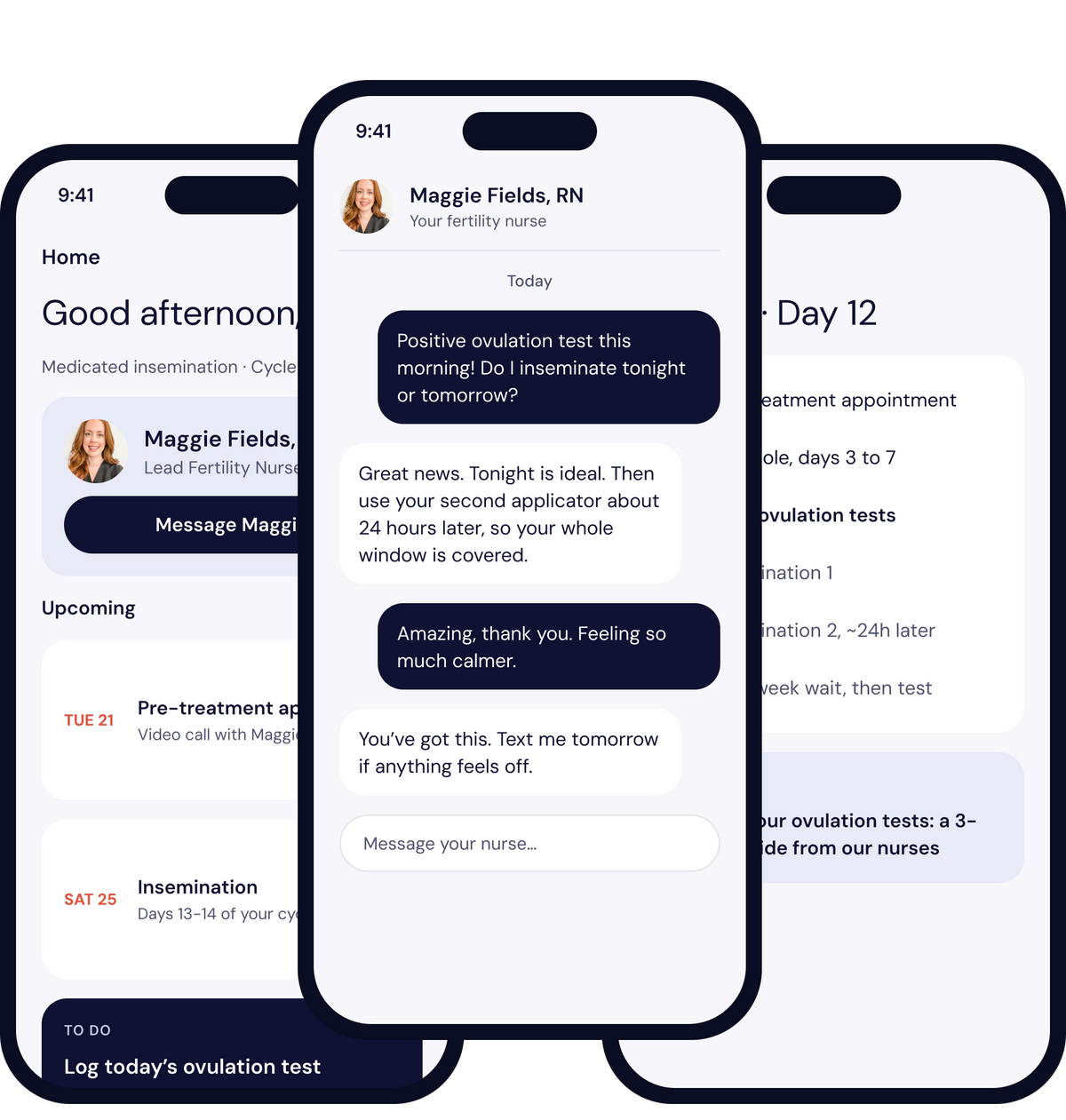
Your plan, your cycle timeline, your nurse and expert-written guidance, all in one app.
See Béa in action.
Short videos from our team, so you know exactly what to expect before you start.
1:04
0:30
The questions you might ask Reddit at 2am. Answered by a fertility expert.
Answered by a specialist fertility nurse who gets to know you from your first cycle.
What is ICI, and how is it different from IUI?
Intracervical insemination (ICI) places a semen sample right at your cervix and holds it there for up to 5 hours in a cervical cap, giving it a head start toward the egg. Cervical mucus creates the perfect chemical environment for sperm cells, giving them their best start as they head towards the egg. Intrauterine insemination (IUI) injects a washed semen sample directly inside the uterus using a catheter passed through the cervix, which is why IUI needs a clinic. The Béa Applicator makes ICI possible at home, with a fertility nurse to guide you.
How is ICI different from IVF?
IVF happens in a fertility clinic. You take injectable medication so your ovaries grow several eggs, the eggs are collected in a short procedure under sedation, and they are combined with sperm in a lab. An embryo is then placed in your uterus. ICI works with your body’s natural process. Sperm is placed at your cervix, and fertilization happens inside your body, just as it would after sex. ICI is far less invasive and costs a fraction of IVF, which is why many people try it first. IVF may be the right place to start if your fallopian tubes are blocked, sperm count is very low, or your age or diagnosis means time matters. Our free, 2-minute eligibility assessment and fertility nurses can help you work out where to begin.
Is ICI right for me?
ICI can suit you if you’re trying with a partner or donor sperm and want a gentler step before IUI or IVF. It isn’t right for everyone. Our 2-minute eligibility assessment checks your history for anything that rules it out, and our care team is a text away if you want to talk it through.
Do I need medication?
Not everyone does. If you ovulate regularly on your own, insemination treatment may be all you need. If ovulation is irregular or unpredictable, or if you’ve tried intercourse or insemination and it hasn’t worked for you, then medication can help. A licensed OBGYN decides based on your medical questionnaire whether medication is right for you or not.
What happens at my pre-treatment appointment?
Most appointments take around 15 minutes, but they’re never rushed. Your fertility nurse will take as long as you need to walk through tracking your ovulation, using the Béa Applicator and, if you’re prescribed it, taking your medication. Bring every question you have.
How many cycles of Béa are right for me?
Most people choose three cycles. It often takes a few cycles to get pregnant, and three gives you time to find your rhythm. The insemination treatment comes in 1, 3 or 6 cycles. Medicated insemination comes in 1 or 3 cycles.
What if the licensed OBGYN doesn’t prescribe me medication?
Then we’ll tell you why, and what we’d suggest instead. We refund everything except a $25 processing fee, and send you our recommendations of what options might be available to you.
Do I need in-clinic monitoring with letrozole?
Not always. Letrozole is a short, five-day course of pills taken at home, and many people take it without in-clinic scans. Your prescribing physician will decide whether it’s right for you based on your health history.
Will ovulation medication thin my uterus lining?
That’s a known effect of clomiphene (Clomid). Letrozole is much less likely to affect the lining, which is one reason physicians often prefer it.
Letrozole or Clomid?
If ovulation medication is right for you, a licensed OBGYN will prescribe letrozole. For most people letrozole has fewer side effects and is kinder to the uterus lining, and for PMOS the evidence favors it over Clomid.
What if I already ovulate? Will letrozole help?
Medication can make ovulation more predictable, and sometimes release more than one egg. An OBGYN will tell you whether it’s likely to help you based on your medical questionnaire.
Who prescribes, and where does the medication come from?
An independent, US-licensed physician from MDI Medical Group, PC (mdintegrations.com) reviews your medical intake and prescribes medication only if it’s right for you. Prescriptions are filled by Honeybee Health (honeybeehealth.com), a licensed US pharmacy, which ships your medication directly to your door.
Is the Béa Applicator FDA-cleared?
Yes. The Béa Applicator is an FDA-cleared Class II medical device. This is the highest classification of at-home insemination device available on the US market today.
Can I use my HSA or FSA?
Yes! All our products and services are eligible for HSA/FSA. Select Flex Pay with HSA/FSA during checkout.
Fertility care at home, ready when you are.
Start with a free 2-minute eligibility assessment. From $150 a cycle. HSA/FSA eligible. Fertility nurse support always included.
Notes and sources
1. Based on a postcoital test of another cervical-cap device vs intercourse: 11/13 (85%) showed higher cervical-mucus sperm scores; among responders, average 3.23× (Pelekanos, 2015). Not Béa; no syringe comparison. PCT scores are semi-quantitative and don’t predict pregnancy. Results vary.
2. 39.28% pregnancy rate among 56 Béa users who completed up to three Béa insemination treatment cycles and reported outcomes between June–Dec 2023. Average age 37. Internal observational data; no control group. Results vary and are not guaranteed. “Pregnancy rate” refers to reported pregnancies during/after treatment; it is not a live-birth rate.
3. IUI costs about $1,363 per cycle (Manfredi et al., 2023). Actual costs vary by age, health and clinic.
4. The eligibility assessment checks for contraindications and recommends a treatment plan. If your plan includes medication, you’ll also complete a medical questionnaire, and a licensed OBGYN reviews it before anything is prescribed.
The Béa Applicator is an FDA-cleared Class II medical device. Medication is prescribed only if an independent, licensed OBGYN decides it’s right for you after reviewing your medical questionnaire. Not everyone qualifies. Available in all 50 states and Washington, DC.
Support from our care team is for education and guidance on your Béa plan, including using the Béa Applicator, and is not medical advice, diagnosis or treatment. Questions about ovulation medication should go to your prescribing physician through the Treatment Hub. For any other questions about symptoms or a diagnosis, please contact your primary physician. If you have a medical emergency, call 911.